I Stopped Paying for Five AI Tools. Movby.ai Fixed the Mess.
2026-07-12
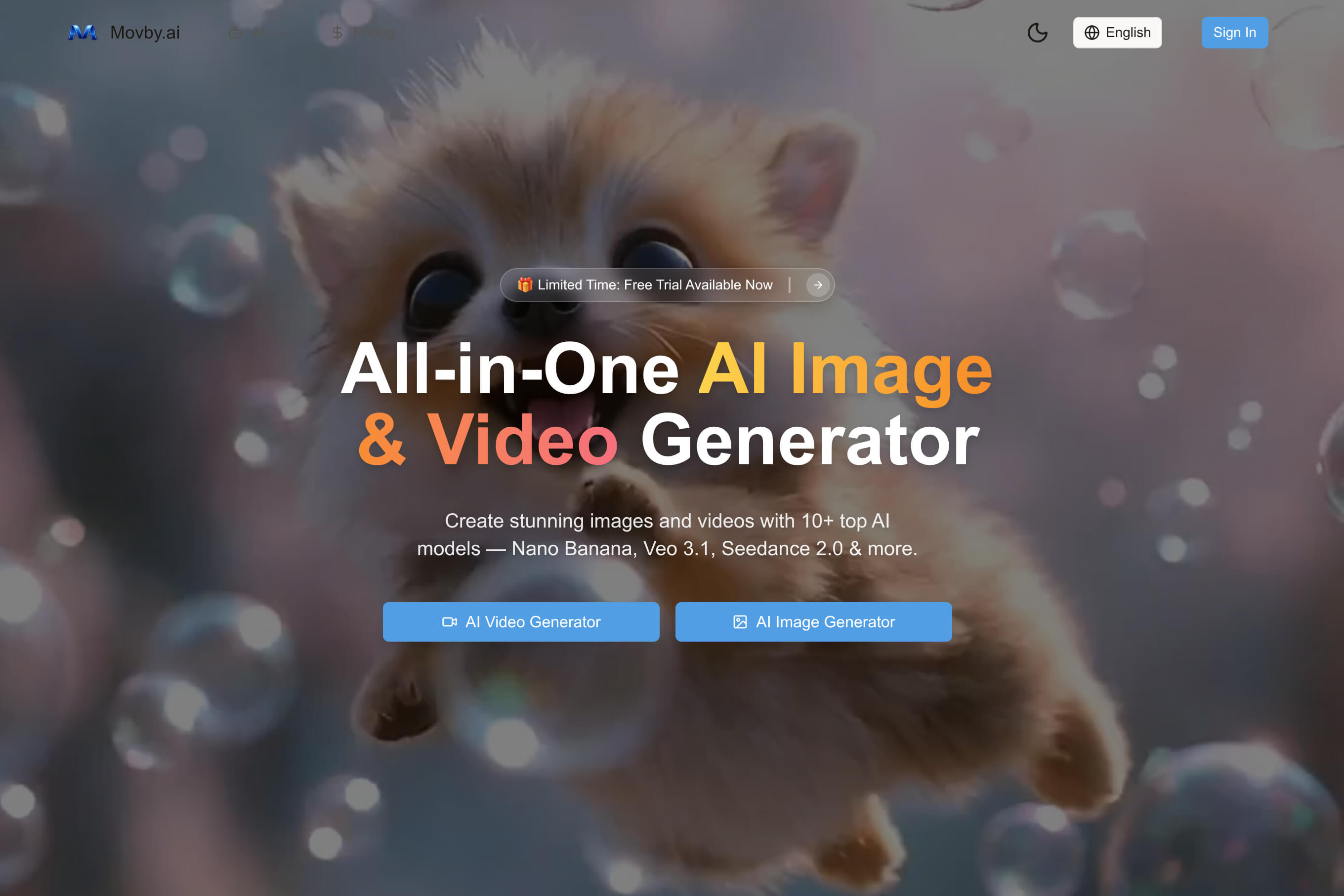
Last month I opened my banking app and counted how many AI subscriptions I was still paying for. Four active. One I forgot to cancel. Another trial that auto-renewed while I was traveling. The worst part? I still bounced between tabs whenever a client asked for a thumbnail and a short clip from the same idea.
That was the moment I tried Movby.ai. Not because the homepage promised magic. Because I was tired of managing logins.
The Real Problem Isn't "AI Quality" Anymore
Most people I talk to aren't stuck because the models are bad. Nano Banana, Veo, Seedance, Flux — the outputs can look great when you finally get them. The pain is everything around the work:
- One tool is strong at images but useless for video
- Another locks the best model behind a separate plan
- You write the same prompt three times in three UIs
- Free tiers watermark everything you might actually publish
- Commercial rights are buried in fine print until you already spent the afternoon generating
If that sounds familiar, you're not picky. You're just trying to ship content without turning creative work into admin work.
What Movby.ai Actually Is (And Isn't)
Movby.ai is an all-in-one studio for AI images and short videos. One account, a credit balance, and access to a pile of models people usually buy separately: Google Veo 3.1, Nano Banana, ByteDance Seedance 2.0, Grok Imagine, GPT Image, Flux, Kling, Hailuo, Seedream, Runway, and more as they add them.
Important distinction: Movby.ai is not Google, OpenAI, or ByteDance. It's an aggregator. You generate on their site; they run the models for you. That matters if you've been burned by "official" waitlists and still need a deliverable this week.
I started on the free signup credits — 30 credits, no card — and ran the same product prompt through a few image models before I touched video. That alone told me more than any feature list.
Images First: When You Need Something Usable Tonight
The AI image generator covers text-to-image and image-to-image in one place. You pick a model, set ratio and quantity, write the prompt, and wait. In my tests, stills usually landed in the 10–30 second range, which is short enough that iterating doesn't kill your evening.
Nano Banana when consistency matters
I care less about "wow" and more about whether the character's face survives take two. That's where Nano Banana earned a permanent slot in my workflow. Google's Nano Banana line (including Nano Banana 2 / Pro where offered) is strong for generation and edits — restyling a photo, keeping a product shape intact, fixing lighting without inventing a new brand.
Practical uses that stuck for me:
- Social posts that need a clean subject, not stock-photo mush
- Quick product mockups before a designer opens Figma
- Concept boards for clients who can't visualize from text alone
If your itch is "I know what I want but I can't draw," Nano Banana scratches it without forcing you into a separate Google subscription.
When text on the image has to be readable
GPT Image (ChatGPT Image) is the one I reach for when the brief includes headlines, packaging labels, or poster copy. Flux and Seedream cover other lanes — stylized art, sharper commercial looks, draft ideation. The point isn't that one model wins forever. It's that you can switch without opening another invoice.
There's also single-image upscale toward 4K if a draft is almost right but soft for print or a big thumbnail. Small feature, big relief when a client says "can you make it sharper?" at 5 p.m.
Video Without the Tool-Hopping Tax
Still images don't carry a launch anymore. Reels, ads, storyboards — someone always asks for motion. Movby's AI video generator handles text-to-video and image-to-video under the same login. Videos took longer for me than images (often a few minutes depending on model and length), which is normal. What isn't normal is being able to try Veo, Seedance, Kling, Hailuo, and Grok Imagine without five different wallets.
Veo 3.1 when you want cinematic polish
I use Veo 3.1 when the shot needs to feel directed: camera language, lighting, that "this could be a real B-roll pull" quality. Text-to-video for a scene from scratch. Image-to-video when I already like a still and want it to move. There's also an ingredients-style path with reference images when character consistency across the clip matters.
Resolutions go up through 720p / 1080p / 4K options depending on what the page offers for that run. For YouTube thumbs that become short hooks, or ad concepts where "good enough AI" gets rejected in review, Veo is usually the safer first bet.
Seedance 2.0 when story and sound matter
Seedance 2.0 is the one I open when a clip needs more than a floating still. ByteDance's model leans into multi-shot storytelling and native sound — useful for short marketing sequences, product motion with ambience, or drafts where silence makes the whole thing feel unfinished.
You can work from text or images, and the multimodal angle (references for look, motion, even audio guidance where supported) is the itch-scratcher for people who hate prompting in a vacuum. Clips in the 4–15 second range fit social and ad tests better than pretending you need a three-minute film from day one.
If Veo is your "make this look expensive" button, Seedance is closer to "make this feel like a scene." I generate both when a campaign is on the line and keep the winner. Same workspace. Same credits. No argument with procurement.
Pain, Itch, and What Actually Feels Good
Pain: Paying for Midjourney and a video lab and whatever launched last Tuesday, then still exporting with watermarks on the free tier when you needed a client-ready file.
Itch: Knowing a better model exists for this job, but not wanting another subscription just to A/B one prompt.
Pleasure: Writing one idea, running it through Nano Banana for the keyframe, animating the favorite in Veo or Seedance, downloading HD where the model allows, and moving on with your day.
That loop is the whole product pitch, minus the brochure language.
Pricing That Matches How People Actually Buy
I care about two numbers: can I test without a card, and do paid plans unlock commercial use without drama.
From Movby's live pricing page (always double-check movby.ai/pricing because packs change):
- Free: 30 credits at signup; limited-time daily free uses on some T2I / T2V / I2V models. Treat free outputs as personal / non-commercial unless the current page says otherwise; watermarks can show up on free-plan results.
- Pay as you go: credit packs (Small / Medium / Large in the ballpark of $10 / $30 / $80) if you hate monthly commitments. Higher packs lean commercial; packs are typically watermark-free and valid for a long window (they list 365 days).
- Monthly: Starter around $19.9 (600 credits), Standard around $49.9 (1800), Premium around $99.9 (3800). Monthly tiers advertise commercial use, watermark-free results, and ad-free experience. Unused monthly credits don't roll over — so don't buy Premium "just in case" if you'll only generate twice a month.
Cancel from Billing when you're done; the paid period still runs out normally. Support sits at support@movby.ai if something weird happens with a charge or download.
For me, free credits answered "is the quality good enough?" Pay-as-you-go answered a one-off campaign. Monthly only made sense once I was generating weekly.
Who This Is Actually For
Creators who post often. Freelancers who need mockups before the real shoot. Marketers testing creatives. Small teams that can't justify five SaaS seats. Designers who want a draft layer without opening After Effects for an eight-second loop.
It's less ideal if you need a full NLE, long-form editing, or vendor-level SLAs from Google directly. Different job.
How I Run a Real Session
- Open the image or video tool and pick the mode (text or image-driven).
- Choose the model for the job — Nano Banana for editable stills, Veo for cinematic motion, Seedance when sound and multi-shot control matter.
- Set ratio, resolution, duration or quantity. Don't overthink the first pass.
- Generate, then change one variable: prompt, reference, or model. Download the keeper.
That four-step rhythm is boring on purpose. Boring workflows get used.
Bottom Line
Movby.ai didn't invent AI images or AI video. It removed the part I hated: the pile of half-used subscriptions and the mental tax of remembering which site does which model this month.
If you're comparing models, start free, run one prompt through the image generator and one through the video generator, then decide with files on disk — not with marketing pages. Deep links to Nano Banana, Veo 3.1, and Seedance 2.0 save you from hunting menus when you already know what you want.
One account. Enough models to stop arguing with yourself. Credits that make the cost visible before you click Generate. That's the version of AI tooling I was willing to keep.